Idiots Idiots Hot


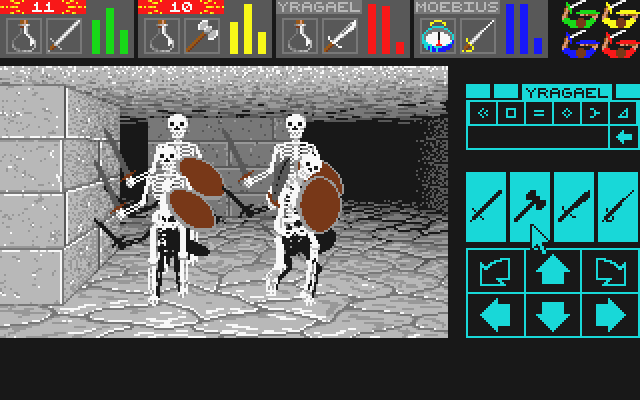
itiots_imageConsider for a moment -- you’re a soldier in a big concrete bunker.  Coming up the hill towards you are: a) a group of 20 men with rifles, and b) a tank.  Beside you in the bunker is an artillery piece, the words “Anti-Tank Gun” written on it.  Which should you fire at?  The men, or the tank?  This isn't a trick question; go with your gut.

 If you picked the tank, you’re smarter than a cooperative game's deck of cards.  It's not the highest bar you’ll ever clear, but congratulations nonetheless.  You’re a more qualified opponent than every cooperative game on the market, and likely a lot more fun to be with.

If you haven’t guessed I've been off of co-ops for awhile now.  Initially I found the concept interesting.  I enjoyed Lord of the Rings and Shadows Over Camelot.  Both were intentionally hard, and that meant challenge, and bringing friends together in a team meant camaraderie and a shared spirit of victory or defeat.  Cooperative games should be just the thing for me and my buddies, but they’re not.  They’re flat; they’re lifeless.  They manage to be arbitrary and predictable simultaneously, which is a pretty impressive display of failure when you think about it.

So what’s my problem?  Why do I dislike cooperatives when everyone else seems to love them?  More than a few are very popular right now and game publishers are pumping them out with wild abandon, presumably because they’re in demand.  I've played my share in the last year or two (they’re almost unavoidable now) and with each I’ve come to the same conclusion: this one doesn't work either. They just don’t do ring the bell for me.  When I recognized this was happening a few months back I spent the time needed to figure out what my problem was.  This was my conclusion:

It’s not me, it’s you.  You’re all idiots.

Now hear me out – this theory is pretty compelling.  It's simple; it’s straightforward; it thoroughly resolves the question and makes me feel better about myself.  Since that may not be enough for you I'm going to spend time to lay out some indictments against cooperatives and as best I can tell they aren't the usual suspects that get trotted out on the subject.

Here’s the heart of the matter: cooperatives are puzzles.  It’s pretty much that simple; they’re inanimate objects.  There’s no intelligence, no insight.  There can’t be.  No amount of time or effort spent during development can breathe life into an opponent made out of cardboard.  Puzzles are fine and I have dozens, but I generally do them alone, and I generally do them once.  “Alone” and “once” aren’t two facets boardgame publishers can afford when fellowship is an imperative to the industry’s survival.  And to some extent I think that the “fellowship” concept is the primary driver behind the ever-growing number of cooperative titles.  Cooperatives provide a low barrier to entry emotionally, and publishers are using the concept to get unlikely players to the table.  A laudable goal of course, but it has pitfalls.  The game this wider audience sits down to needs to be engaging and worth returning to, and both are tougher to pull off with a puzzle.

Ok, so I dropped you in a concrete bunker in the first paragraph.  Now I’m going to drop you into an even less desirable location -- a cooperative game designer’s office.  Smaller, darker and less ventilated, those who dwell within deserve our sympathy, because they are working with one hand tied behind their back.  Instead of a big gun they get a blank sheet of paper, tasked to create a game whose requirement set is much larger than that for competitive titles.  They don’t merely have to create a level playing field.  They have to create an artificial game player as well, one that can compete against real live humans.  That’s very tough – there’s no computer program here.  In boardgames there’s no way to examine what’s on the table in order to respond.  The cooperative boardgame designer is required to develop narrative from an unknowing, inanimate object.  The inability to sense game state means they have to find a way produce an intelligent response with what is essentially a bag of puzzle pieces.  How on Earth do you do that?

By my measure, game designers have largely failed to achieve this herculean task.

Deaf and blind, cooperative games need to simulate some sort of decision-making process.  They need to fake it, and that means random bad news and plenty of it.  Generally done via a deck of cards, the theory is that a sufficient number of “events” for the players to deal with will provide a challenge.  But often these decks-of-doom do just the opposite.  I’m not speaking of a bad shuffle providing a too-easy or too-hard session (two very-real possibilities that you’ll see discussed aplenty.)  I’m speaking of a gaminess where players disengage, where players don’t feel obligated to make decisions based upon the reality defined by the game’s ruleset.  Against real opponents your decisions are scrutinized.  Each move is examined by a thinking individual that can react with competence, and if you blunder you’re going to pay.  That gets the scare up in you.  But a deck of cards can’t do that.  A deck of cards is as likely to hit you at the strongest part of your game as the weakest, so poor play often goes unpunished.  In fact poor play can even be rewarded when you leave one position vulnerable and exposed in order to super-power another.  You can (and likely should) leave some positions uncovered in hopes they won’t get hit by the random draw this turn.  The game begins to de-evolve, becoming a search for seams in the ruleset that take you away from the game’s conceptual goals.  That’s not fun, and when you explain to the new guy next to you that “you don’t need to cover London anymore because it's already in the discard pile” they aren't going to come away with a high opinion of the title.

Here’s the thing – this concept I’m raising isn’t about your unthinking cardboard opponent, it’s about you.  When you’re playing a real opponent he keeps you honest.  He forces you to play carefully.  He makes you develop a broad, unified strategy covering the entire board.  He makes you play hard.  A deck of cards can’t do that.  A deck of cards can be active, but it can’t be reactive.  At best you start gaming the rules and working the angles because there’s positive feedback in doing that.  At worst you just stop giving a damn.

The other issue I have with Event Decks is that they're essentially a simulation of my deaf grandmother.  You and your friends may tell each other to draw a card when you play cooperative games, but I have a different phrase – “Listen to Eunice.”

You see my Grandmother Eunice lost her hearing as she aged, and she was well aware that she couldn’t react to other people’s comments or questions anymore.  So if she wanted to be in the discussion, she needed to lead it.  Not just lead it, she needed to dominate it.  As long as Grandma Eunice kept talking she knew what the topic was, and that was just fine with her.  We kids had no choice but to listen to the same stories over and over without asking questions or making comments.  We loved Grandma, but it was awfully tedious.

That’s what an “event deck” has to do to maintain narrative.  It can't hear, so it can't react even to itself.  Regardless of game state, the deck is going to keep talking about whatever it wants.  We smile and nod like we did with Grandma, but c’mon.  It’s a lackluster session.  Generally nobody complains because cooperatives really can't get better.  We settle for second best because we want the fellowship.  

Now, the first time you try a new cooperative you’re likely not aware of what resides in that event deck and there’s some fun in discovery.  The first time we heard Grandma Eunice’s stories they were entertaining too.  But that’s fleeting – once seen assembled a puzzle loses its luster, and the assembly time is largely determined by the amount of cardboard in the box.  Arkham Horror can bring it for more than a few plays because there are so many cards.  Castle Panic . . . my boys were done with it in ten minutes.  To their credit they lasted a few minutes longer than I did.

Some cooperative games attempt to minimize the issue of arbitrary story by keeping the card deck simple and its actions smaller in scope.  D-Day at Omaha Beach (a game I like in spite of closely resembling the example I started this article with) uses its card deck for target selection.  No single card is of significant enough magnitude to throw the game off kilter or appear as a break in narrative.  Each card drawn activates attacks on multiple units (often from multiple locations), and has the effect of steadily degrading your position on the battlefield.  That’s a pretty reasonable reflection of the game’s theme, and multiple card draws of lesser effect mean that the law of large numbers is available to produce a more even-handed result.  This is analogous to drawing a disadvantageous card in solitaire, where no single event is significant enough to break the theme or produce a bizarre change of state.  You get a play that feels more like a balanced and well-considered response.  In my opinion this is better, but still not gripping.  Had I been playing a buddy he assuredly would have picked a soft spot and punched hard, trying to break my line to upset my battle plans.  That is reactive gaming.  It keeps me honest; it makes me play for real.  It makes try to figure out what he's thinking.  No deck of cards will ever be able to do that.  No deck can identify a weak position or capitalize on a lucky die roll.  I have yet to see one that is able to capitalize on combinations of powers.  If anybody knows of one I’d love to hear about it.

If the last few years are any indication, game designers are aware that they’ve wrung out the capabilities of static protocols and event decks.  In the absence of intelligence in the automated opponent, the concept of a “secret traitor” has become so common that I pretty much assume it’s in a cooperative’s ruleset before I read it.  A capitulation to shortcomings, traitors provide a real-live human to help the game’s response.  Voilà, real live decision-making magically appears in the play.  There’s an opponent now, and the game once again takes life.  But the group hug comes to a very abrupt end.  “Traitor” turns Kumbayah into a session of distrust and backstabbing, a game that shares nothing in common with the spirit of cooperative play.  Often someone will describe a game as “cooperative with a traitor element” and I bite my tongue to avoid blurting out “it’s a traitor game.”  It’s not worth debating since I don’t think there’s any game billing itself as a "traitor game."  I don’t particularly like the traitor concept, but that’s for other reasons.  Unfortunately cooperative and traitor are often conflated.

The remarkable thing that keeps falling out of this train of thought for me is this – the incredible lack of games with two or more teams playing against each other.  Teams are true cooperative play.  A powerful intelligence engine operates on each side of the table, yet the game successfully executes virtually all the benefits of cooperative gaming.  It’s better play.  The video game industry has spent fifteen years and billions of dollars getting off of AI, networking players in social cooperatives that actively compete with each other.  Meanwhile board games shun the concept.  I can think of maybe two dozen boardgames where teams of two or more players play in direct conflict with each other.  Frankly I’m stretching it on a couple of those.  I teach Rush ‘n Crush as a team game because the game kind of blows without them.  Last Night on Earth can be considered team vs. team if you shut one eye and squint a bit.  Wings of War is best played in teams and it makes perfect sense thematically to do so.  It’s truly team gaming.  But in public venues I get push-back from non-wargamers.  They want to play every-man-for-himself.  I’ve said this before: it’s almost as if team play isn’t considered honorable in the boardgaming culture.

So this is the Whiskey-Tango-Foxtrot moment I come to as I watch yet another cooperative title play out on the table in front of me.  “We’re playing against an idiot” invariably passes through my mind as some out-of-context card comes off the top of the deck or some useless power is invoked that waste’s the game's turn.  I’m left wondering why the industry is on such a jag to produce games built on a substandard concept.  The short answer is almost assuredly “because they sell.”  But I’m done.  Cooperative games may sell, but I’m not buying anymore.

S.


Sag is a somewhat regular columnist for Fortress: Ameritrash.

 Click here for more board game articles by Sagrilarus.

Powered by JReviews
Comments (63)
  • avatarDair

    I agree with a lot of what you say Sag, but I think the players' mentality can overcome some of the problem with cooperative games. I have played Arkham Horror about 25 times with just the base game over the course of 3 or 4 years. It doesn't lose anything for me because I have actively avoided learning which locations are more likely to have a gate. I don't want to know the system and I only play once every month or two, so I am not learning indirectly through constant play. This has allowed me to keep the game fresh and the difficulty at a reasonable rate. I think anyone can do this and it is well worth the money I have saved on not buying all the expansions.

    Edit: I will add that this will only work with a good coop. If the game AI is not constructed properly and can't be competitive due to constantly taking random and idiotic moves, no mindset will overcome that.

  • avatarSchweig!

    You've asked on the forums whether you should play Ambush! After you've made these statements:

    1) "No amount of time or effort spent during development can breathe life into an opponent made out of cardboard."

    2) "In boardgames there’s no way to examine what’s on the table in order to respond."

    I respond: FUCKING YES YOU SHOULD!!!

    You'd be amazed. I know it's a solitaire game, not a coop, but it achieves exactly these two things you deem impossible in board gaming, as do many of the more complex solitaire wargames like Tokyo Express, and so on. (B-17 for example does not.)

    However, although I disagree with these two premises in general, I agree to them when concerning non-solitaire games, because these are achieved only by adding more mechanisms and complexity that wouldn't work in a cooperative game, or at least one that intends to get non-gamers to the table easily, the main reason - as you point out - behind playing a coop to begin with.

  • avatarubarose

    Arkham Horror works because you're opponent is supposed to be enigmatic; chaos; without human reasoning; mysterious. Puzzles are solved. Mysteries are revealved. The top card in every deck is a mystery. You have some clue as to what is more likely to be on that card, you are an investigator after all, but you don't know exactly what it will be until you reveal it.

  • avatarwice
    Quote:
    "In boardgames there’s no way to examine what’s on the table in order to respond."

    I don't think it's necessarily true. It really depends on the designer whether or not the AI is just a bunch of random event cards, that don't take into account what's on the board. To take your example: for the anti-tank gun, the rule may be "roll a die and fire at something based on it", but it can easily be "fire at the closest tank, if there's one; fire at something else otherwise".

    As I heard, e.g. Gears of War has a pretty good AI in this regard.

  • avatarMalloc  - Spot on

    Sag, you have nailed it. These games are everywhere and well they mostly suck.

    Arkham kinda works, but i think that's because they have expanded the thing to the point that you need to play it 100 times to see everything. Still i often find the game to turn into a min/max session directed by one or two experienced players gambling on what events are going to show.

    I would Argue the BSG is a good traitor game, not a coop game at all.

    I personally hope this little FAD is winding down, time will tell.

  • avatarSuperflyTNT

    Disagree, Sag, for once. Good AI, be it made of silicon (Oblivion, Fallout...) or cardboard can be a good opponent. Not, obviously, the same as a human, but certainly different. Well designed games can react to situations, and while at the root, yes, they are nothing more than puzzles, there's nothing wrong with playing a puzzle if that's what you're looking to do.

    The problem here lies with the player. You apparently are looking for a challenging experience where you can outsmart the opponent, be it cardboard or otherwise.

    Maybe try playing a game for the storytelling aspect, to have some fun rather than just win and be the smartest guy in the room. People say to me all the time like "how can you like this game?" It's simple. I'm not trying to prove anything to myself or anyone else. I'm not concerned with winning.

    I'm concerned with having a good time with partying with friends and gaming it up, sharing an experience, and watching a story unfold. It's a philosophical difference. Not the reaching of the goal that's important, it's the goal itself and the fun had on the way there.

    Also, there's not as many TvT games out there as others, but there's plenty. Conquest of Nerath is one off the top of my head, and Heroscape played in teams is epic. I agree, though, more TvT would be awesome since I generally get an even numbered crowd.

  • avatarMattDP

    I agree. I've made similar statements in articles before - glad you've joined the club.

    I do like a very few co-ops, but they work in spite of, not because of, the co-op setup and always because they offer something besides the actual game mechanics, usually narrative, atmosphere or huge variety (ideally all three).

  • avatarrepoman

    I, too, am not a huge fan of co-ops in general. However, their appeal is not hard to figure out. You do mention the "camaraderie" aspect but sort of shrug it off. I posit that this is about the only reason to play a co-op. They are not about strategy or analytical ability. It's about you and your friends being dropped into a horrible situation and working together.

    Also, for the most part, not including the "traitor" games which you correctly (and brilliantly) point out are not the same thing at all, these games eliminate confrontation allowing people such as my wife who hates "meanness" to enjoy a board game.

    I did have one of those eye opening "Hey I never thought of that but by Gum...he's totally right" in regards to your thoughts on team games.

    To your list of team games I think you might stretch a bit and include the all against one co-ops. Fury of Dracula and Mousqueteer's Du Roy (ya I know I spelled it wrong) and perhaps even Letters from White Chapel. The give the fellowship of a co-op with the intelligence of a human opponent.

  • avatarSagrilarus  - re:
    SuperflyTNT wrote:
    Maybe try playing a game for the storytelling aspect, to have some fun rather than just win and be the smartest guy in the room.

    If I'm just a spectator to story, I'll find a book that interests me. Games that produce a story at random tend to be disjoint and incoherent, a story with no steering wheel. This isn't about smartest guy in the room, it's about the destination. "Arbitrary narrative" just doesn't hold my attention.

    S.

  • avatarmikecl

    Co-op games also leave me fairly flat and I've got a number of them. I was never a big Arkham Horror fan because the game engine to me felt sterile and I just could never get into the card narrative which felt contrived.

    However, for some reason I do like Defenders of the Realm. It's my favorite coop and I also own Ghost Stories (too tight and mechanical again).

    Something about the monster generals marching on Monarch City while their spawn randomly proliferate and the need to come together to do battle just works for me. And the characters are interesting too. Pandemic kind of worked for me too for awhile because the idea of a medical team working together to eradicate disease is kinda cool. Perhaps not coincidentally they share the same mechanic, but I think Richard Launius's implementation (Defenders) is less predictable than Matt Leacock's (Pandemic).

  • avatarGary Sax

    You might consider playing Fields of Fire. I've never played Ambush, but that may have the same qualities as well.

  • avatarSuperflyTNT

    Sag, being a spectator isn't the case. There's decisions involved. I guess you could get a Choose-Your-Own-Adventure book, sit with several friends and debate about the next choice over some rum and cokes, but it's not the same.

    A game like Ravenloft is awesome because of the stories that unfold. The tension that builds from getting totally fucked over with traps, bad encounters, shit like that.

    To another point, if you look at games like Dungeonquest, it's everyone against the board. Do they fall into the same trap of being a game with a cardboard opponent? I often see games like Runebound or DQ as a "multiplayer solitaire" but I like them anyhow because of the stories that unfold. And unlike a book, you're a part of the story, not a spectator. Same with co-ops that are narrative in nature.

    I agree that Ghost Stories or Pandemic fall into the category you're describing, the puzzle with no brain type game, but I like them anyhow. Sometimes puzzles are fun, and everything's more fun with friends.

    And FYI: I wasn't using the "smartest guy" analogy to be perjorative. Just to describe what I see as the impetus to play a game for the sole purpose of winning.

  • avatarwaddball

    Puzzles, sure, but more variable than most things that share that name. Fundamentally, though, I think you're right: co-ops are shared puzzles, more akin to sitting down and solving a jigsaw together than playing chess (though solving a jigsaw under time pressure is a closer analogue).

    Designers use feedback mechanisms with varying degrees of success. Pandemic's reshuffle is a great idea, while the LOTR LCG's encounter deck strikes me as exactly the sort of thing you're complaining about.

    I don't see such a significant difference when it comes to competitive games with similar mechanisms. Sometimes you leave yourself vulnerable but your opponent simply can't make the "intelligent" play to punish you because it's not available to them. But of course the odds are greatly increased that next time around you won't get away with it. That's just a function (usually a desirable one) of a deck of cards.

  • avatarSagrilarus

    LOTR LCG's encounter deck is largely why I went from mulling this issue to writing about it. It was uninspiring to the point of being a chore to get past instead of a game to play.

    Yet, the game gets good reviews.

    S.

  • avatarSagrilarus

    By the way I emailed this article to my Kindle and listened to if via text-to-speech during my drive into work today. It was kind of creepy. Somebody else speaking my words in a cold mechanical voice made me a little uneasy.

    I had a "Now available on Kindle!" advert in the footer text but apparently it disappeared on the way to the front page.

    S.

  • avatarwaddball

    Yeah, I wondered if LOTR:LCG might've been involved.

    My working hypothesis is that this is what you get when game design is not a labor of love. It's not "here's this great idea, now who will publish it?", but rather "you, employee with designer in your job title, make a game for us, and quickly while we have the license". With one, you get the occasional brilliance (and failures) of any artistic endeavor; with the other, you get a strong sense of a commodity, of "good enough, let's get it to market". And it is, so they did.

  • avatarSan Il Defanso

    I've been pondering this one myself. I still enjoy the odd game of Death Angel, but almost totally as a solitaire exercise.

    I especially noticed it this past week, when I played a game of Arkham Horror, and then Fury of Dracula just a few days later. It struck me that Arkham Horror is getting a long way on sheer mass. The base game by itself is just a little too predictable after about 5 games or so. Fury of Dracula, on the other hand, was much more vibrant and exciting, because I was playing it against other people.

    They will never invent a cardboard AI good enough to actually hold a candle to playing against other people. They start out interesting, but they so rarely surprise me. That's why BSG and Fury of Dracula have risen to the top as the best games that involve cooperation.

  • avatarKen B.

    Don't know what to say, man--I like co-ops just fine. They're perfect for casual gameplay, more people will try co-ops than competitive games that are completely unfamiliar to them, and sometimes, it is fun just to beat the puzzle.

    I think "Co-op with traitor" is also perfectly legitimate, because it solves the 'boss player' problem. Why listen to this guy barking orders...when he could very well be a traitor? Yes, it becomes either a team or one-vs-many, but then we're arguing semantics.

    Most times I ignore team-play options because they're either not included, or worse, tossed in as an appendix as an afterthought. If they're not worth their time to focus on, then it's not worth mine, either. They get paid to design, I don't get paid to play.

    So to each their own, man. But I dig co-ops, along with games from every other genre too.


    Also, and this is no slight on you, Sag, but hot damn does the boardgaming hobby have "old-man-itis" sometimes. "These kids today with their co-ops and their deckbuilders...consarn it! Them ain't no boardgames!" *Spitang*

  • avatarMattDP

    Having said this about co-ops from the very beginning, I feel hugely vindicated.

    Perhaps this is the beginning of the end of the popularity of these monstrosities. If even San Il Defanso (whom I remember as totally loving Death Angel) is starting to get cold feet then it could be that the gaming public's love affair with these things is over. If so, it's been bought on by overexposure - these things seems to be everywhere now.

    "Co-op with traitor" and "team vs team" (i.e. Fury of Dracula) are not co-operative games. They're competitive games in which one side co-operates with one another against the enemy. That's a whole different kettle of fish. Those games are brilliant.

    When I first realised I hated co-op games I had the idea of making a co-op design in which players were purposely forbidden from talking to one another about strategy or game state unless they could - in game - send a messenger piece from their own stronghold to that of a neighbouring player. I figured it would kill the alpha-dog problem and encourage genuine strategic debate as well as creating an interesting dynamic where two players could end up working out a strategy that all the other players knew couldn't work, because they didn't know the full game state. I still think it's an interesting idea, but the problem of course is that everyone would probably ignore the rule. Witch of Salem did something vaguely similar, although much reduced in scope and anti-thematic and which actually made discussing the game without revealing supposedly hidden information difficult to impossible and although I felt it was a brave try, I seem to recall that everyone else hated it.

  • avatarKen B.

    Yeah, we ditched the "no talkie about portals" rule in Witch of Salem. It's still tough even if you talk about portals, and the rule is indeed anti-thematic and stupid.

  • avatarSagrilarus  - re:
    Ken B. wrote:

    Also, and this is no slight on you, Sag,


    I called you an idiot in paragraph 5, so feel free to speak your mind.

    Ken B. wrote:

    but hot damn does the boardgaming hobby have "old-man-itis" sometimes. "These kids today with their co-ops and their deckbuilders...consarn it! Them ain't no boardgames!" *Spitang*


    Cooperatives are the Geritol of boardgames. You heard it here first.

    S.

  • avatarJonJacob

    Another great article Sag. I tend to agree with you for the most part. I do really enjoy Arkham... although the fact that I just sold it tells you how much my group dislikes co-op games. When we get together we might not want to "prove who's the smartest" as people are want to say about Euro's... hell I've said it before too. But we definitley want to compete. There is almost something too modern and PC about the co-op feeling. No victory or defeat is ever as emotional in a co-op and our group never reaches the highs or lows we're capable of without some friendly (and not so) competition.

    We have had epic Arkham moments, definitely. But the amount of work neccessary to make it happen is too much. In that time frame we could have played two different competitive games that gave us all the emotion we wanted. Not the same emotions neccessarily, but who cares?

    I'm still tempted to buy Gears of War so this is a timely article that will make me double think a little. I applaud that. However, regardless of your article quality, the demon's begging me to buy a new game might be stronger and I may walk that co-op road once again. Forever in search of one from that genre that works for our group.

  • avatarSchweig!  - re: re:
    Sagrilarus wrote:
    If I'm just a spectator to story, I'll find a book that interests me. Games that produce a story at random tend to be disjoint and incoherent, a story with no steering wheel. This isn't about smartest guy in the room, it's about the destination. "Arbitrary narrative" just doesn't hold my attention.

    S.


    Again, play FUCKING AMBUSH!

    Your statements hurt me, man, because they are so uninformed.
    And you're an educated and intelligent man.

  • avatarwaddball  - re:
    MattDP wrote:
    I had the idea of making a co-op design in which players were purposely forbidden from talking to one another about strategy or game state


    I like your idea. I think there's a big unexplored space here for new designs (I'm a fan of co-ops--and therefore emotionally fragile, weak, overtly politically correct, too stupid to understand I'm not really playing a game, etc.--so I'm hoping it gets explored).

    Limiting verbal communication has some problems, as we've seen in Shadows over Camelot and Lord of the Rings. It gets into dumb issues around intent, and devolves into "well, I need, um, some help, but not too much help, and certainly NOT the BIGGEST help, but maybe just a little less than that..." kinds of inanity.

    I gather Antoine Bauza's Hanabi limits communication (it formally allows some specific sorts, and anything outside of those is strictly forbidden). Kind of a quirky, themeless game, and seems prone to weird, Bridge-like conventions. Maybe that's unavoidable, but I hope not.

    It would be cool to have communication occur entirely non-verbally. Maybe via card or chit passing. I can imagine something where you put out a piece of public info but also pass something privately to the active player, so they have to infer intentions and capabilities.

  • avatarKen B.  - re: re:
    Sagrilarus wrote:

    Cooperatives are the Geritol of boardgames. You heard it here first.

    S.


    "Hot damn sunsabitches! Get back to yer chits and hexes! Dagnabit cards and their flifferty falffery words! Words belong in the RULEBOOK, ya hear me, sonny?! And this workin' ta-gether sheeyit to blow up some evil-doers...horsepucky!"

  • avatarSchweig!

    Agreed, Ken. And welcome back.

  • avatarSuperflyTNT  - re:
    MattDP wrote:
    Witch of Salem did something vaguely similar, although much reduced in scope and anti-thematic and which actually made discussing the game without revealing supposedly hidden information difficult to impossible and although I felt it was a brave try, I seem to recall that everyone else hated it.

    Witch of Salem is fine if you amend one simple rule: players may share information provided they're in the same space when they do.

    I really like your idea of the messenger pieces. That would be awesome if integrated in a DoaM game.

  • avatarSan Il Defanso
    Quote:
    Perhaps this is the beginning of the end of the popularity of these monstrosities. If even San Il Defanso (whom I remember as totally loving Death Angel) is starting to get cold feet then it could be that the gaming public's love affair with these things is over. If so, it's been bought on by overexposure - these things seems to be everywhere now.

    Here's the biggest thing with a co-operative game. Even if it's terrific, it WILL need an expansion down the line. And you'll eventually need another one after that. Because humans are always smarter than the game, and they will always figure out a way to beat it.

    I do really like Death Angel, but that's as much for it's setting as anything else. It takes care of that frequent problem of wanting to play Space Hulk, but not having exactly two people. But you know what got me to play it some more? The two mission packs. And I bet I'll want more of it before too long.

  • avatarSagrilarus  - re:
    San Il Defanso wrote:

    Here's the biggest thing with a co-operative game. Even if it's terrific, it WILL need an expansion down the line. And you'll eventually need another one after that. Because humans are always smarter than the game, and they will always figure out a way to beat it.

    Oh my, would publishers want to deal with the hassle of reselling the same game to you over and over again?

    S.

  • avatarDrinkdrawers  - re: re:
    Sagrilarus wrote:
    SuperflyTNT wrote:
    Maybe try playing a game for the storytelling aspect, to have some fun rather than just win and be the smartest guy in the room.


    If I'm just a spectator to story, I'll find a book that interests me. Games that produce a story at random tend to be disjoint and incoherent, a story with no steering wheel. This isn't about smartest guy in the room, it's about the destination. "Arbitrary narrative" just doesn't hold my attention.

    S.

    A random, disjointed, sometimes-incoherent story with no steering wheel... kind of like real life, you mean?

  • avatarMichael Barnes

    A lot of what you have to say about co-ops is essentially true- that there are inherent puzzle elements and so forth- but there are a couple of issues.

    One is that there are co-op games that "sense" game state. Gears of War is the best example. It uses if-then statements to "find" the game state and the Locust act accordingly. No, it's still not the same as a person making tactical decisions, but it does simulate a very crude, simple AI.

    Fields of Fire does this extremely well too, triaging enemy decisions based on game state.

    Another issue is that co-op gameplay, in many cases, is inherently thematic and at times essential to conveying a particular theme, setting, or subject matter. It wouldn't make sense in Arkham Horror for it to be a contest between players.

    Like Ken B. (great to have you back on board!), I like co-ops and I think it's a welcome genre to tabletop gaming because it offers another way to play and enjoy games and to get engaged with theme and setting. It's also something of a cultural thing, I think...I remember when Halo came out, everyone was excited about the co-op campaign. I thought "why would you want to play that instead of deathmatch? MUST KILL!" But then, I saw that it really was a new way to play that kind of game.

    Now, tons of video games have co-op and it's a major selling point for many, and that has come over to board games. It's a social trend or something, I think. Non-oppositional gaming.

  • avatarSagrilarus

    The one game that I have run into that senses game state is Civil War Express, which is not the most common title for any of you to come across. It supplies the south on a cascading table so that, if Richmond has fallen, supplies go to Norfolk instead. If both have fallen then Charleston, and so on. Supplies may drop in in the middle of the south, but once a town falls its supplies move to the next town on the list.

    This senses game state to some extent, but guess what? I can look at that table anytime I like to see who's more likely to get recharged sooner, and maybe Norfolk doesn't need the supplies. It's better, but it's still pretty brainless to send materials to Norfolk if I'm pounding on Atlanta's head .

    I appreciate that the social aspect is nice and that there are some themes (or settings . . . I'm not sure where we left that) that simply don't work in a competitive fashion. That's fine, but that doesn't mean the game is good or that the theme should have been taken up in the first place. My experience with co-ops is that they're for the most part C+ games. I think it's much harder to make them good.

    Another dozen of them are due to announce before Christmas.

    S.

  • avatarShellhead

    I will defend co-ops. Not all of them, because some co-op games suck, like Pandemic. But two of my favorite games are Arkham Horror and Death Angel, so I will definitely defend those co-ops.

    As pointed out upthread, a big selling point for co-op games is camaraderie. We are in this together, trying to win as a team. Anybody who is opposed to that on general principle is possibly a selfish jerk.

    It's true that a live opponent is more likely to give you a good challenge than the AI built into a game. But that's a game design issue, and can be solved by shifting game balance against the players. So even though they are up against random elements, the difficulty of the game will require them to play well to win.

    A challenging game still won't necessarily satisfy some people, because the game AI isn't going to have any coherent thought process behind it. Then again, a casual or inexperienced or tired gamer isn't necessarily going to put a lot of thought into their moves either. And some competitive games don't really offer much in the way of variable strategies.

    There is definitely an audience for co-op games: roleplayers. Role-playing as a hobby seems to be in decline in recent years, but there is still a market for people playing games with their friends and working together. It's just that the time investment for the guy running the game can be considerable. So there is definite appeal to a boardgame that can simulate the role-playing experience, even to a limited degree, while letting everybody play on the same side. There are other games that let one player assume a Dungeon Master kind of role (such as Fury of Dracula), but sometimes maybe nobody wants to play the heavy.

    Also, role-players are better at suspending disbelief and accepting the story than other types of gamers. They can take bits of narration from event cards and rationalize them into a plausible story. And it might even be a relief to some role-players to face more random challenges instead of ones carefully calibrated for the current capabilities of the group, as in D&D 3.0 on up. Or for that matter, events and die-rolls manipulated by the DM to keep the story on track.

    It's true that co-ops can have limited replay value. It's also true that a lot of other games can have limited replay value, especially eurogames. I think that a co-op can avoid that trap once there is a critical mass of variability. Arkham Horror definitely has that, and to a lesser degree, now Death Angel does, too.

    Another way that both Arkham Horror and Death Angel prove superior to other co-ops is the way the game AI functions. Instead of just randomly generating challenges, both games introduce monsters to the play space, and then have a secondary function of the event cards also manipulate the movement and location of those monsters in the play space. Battlestar Galactica does the same thing despite not being a co-op, because the behavior of the Cylon Raiders is still based on game AI. Anyway, this approach works well, because even when the same game events come up each game, they can have a wildly different impact with respect to monster movement.

    The dominant leader problem is common with co-ops, but my favorites have avoided that problem as well. Arkham holds too many potential surprises for any one player to anticipate, and Death Angel has those nice instinct cards that can sometimes leave your least-experienced player temporarily in the drivers seat.

    Winning is fun, but I'm able to enjoy games without winning them. But I've played with a lot of different people over the years, and I've noticed that some of them can't enjoy a game unless they are winning. Those people, IMO, are joyless, competitive dicks who need to stay the hell out of my life. Fuck them, they take a fun activity and ruin it with their asshole Type-A personality.

  • JJJJS

    You don't have to put cash down for them, but I don't think it's good to write off any change to the way people play games. Finding new ways for people to interact should always be encouraged.

    Sometimes I much prefer a co-op. I'm not invested in a win so much as a fun game (though winning's fun, duh) but my game group has a couple people who can't stand to be losing and sometimes I don't want to deal with their whiny shit, even though I enjoy their company otherwise.

  • avatarNotahandle

    Good article. I don't think much of coops, mainly because there're very few good ones, so I tend to avoid them. Ghost Stories is excellent, but interestingly the new expansion adds a bad guy player. Pandemic, I just couldn't see the point of having more than one player.

  • avatarAncient_of_MuMu

    I am not a fan of co-ops because of the puzzle/alpha dog problems but some do work, Arkham Horror in particular.

    So as I read your criticisms, I kept thinking that they don't apply to Arkham and I was wondering why, and then it hit me. Arkham Horror does not have the players playing against an enemy that is required to think. Arkham Horror is merely a variant on the adventure game that is a race (eg Talisman, Runebound, etc). The only difference is Arkham Horror has a variable end game timer, rather than the others which are more a race to see who gets to the end first. You are not battling someone else, you are trying to get your task done before time runs out, and you can only minimally affect and predict the timer.

  • avatarKingPut

    Exellent article.

    One point defending co-ops: About a month ago I was up at Uba's house and we played a couple of competitive games and it was getting late and everyone started getting mean and pissy at each other so I suggested we Defender of the Realm. So we broke out DoR and even though we got our ass kicked twice we had a great time and we stopped being pissy and mean to each other because we were working together. This is perfect example of where a co-op works and why the last big game we play at WBC after drinking and not sleeping enough is always Arkham Horror and not some boring pissy analysis by paralysis passive agressive Euro.

    One observation: Have you noticed that GMT and other war game companies are jumping on creating rules for solo play? Labyrinth last year, other games coming out this year and other games in development.

  • jason10mm

    I like co-ops as well. Sure, they are just puzzles, but hell, ALL boardgames are just puzzles. If you choose to ignore theme and narrative (assuming there is any there to begin with) you are left with just mechanics. What a human opponent brings is unpredictability, for a co-op programmed game to replicate that usually requires so much bookkeeping that the game bogs down. But there are some really good qualities of a co-op game that everyone should have some in their inventory.

    A) Easy to teach, or at least can be taught on the fly since the knowledgible can instruct the others without disadvantaging them.
    B) No player vs player animosity. Sometimes some folks just get too competitive with each other, we all know who they are, even if they don't recognize themselves.
    C) Dammit, sometimes puzzle solving is FUN! Yggdrasil, despite being really mechanical, is a lot of fun.

    But yeah, co-ops are kinda predictable, and at the end of the game what do you have? Either you outwitted a deck of cards or didn't, not nearly as satisfying as telling your obnoxious buddy to pound sand :) But just like computer games, the A.I. complexity will improve and we will eventually see programmed games that can replicate a good human opponent.

  • avatarJonJacob

    I can't beleive I didn't mention Space Alert. It solves almost all co-op problems. Your still left with an unthinking AI and a randomly created story but the pace is so brutally quick, even for experienced players, that there is literally no time to think of any of these things.

    Of course the game is not intended for thinking in the sense your talking about, it's just for fun. But man, it's fucking good at that. Few games give me so many LPM (laughs per minute).

  • avatarmjl1783

    You're not making your case fine enough, I think.

    For the most part, game AI in general sucks. Even in modern FPS games, where the enemy is ostensibly reacting to what you do, and their patterns should be the hardest to read, it only takes a few plays of a given section before it becomes apparent your opponent is following a script. If I stay behind this wall and shoot the guy on the catwalk, another one is going to come up and take his place. If, however, I run over to that crate, the first guy throws a grenade and the second tries to flank me. It's a more sophisticated script to be sure, and there are variables that keep it from working out that way every single time, but it's still predictable.

    But, I don't think that's quite what you're getting at here. Just because the AI is dumb doesn't mean the gameplay can't be engaging. You said yourself that it's possible to come up with an imaginary opponent that at least gives the appearance of considered play. It stands to reason, then, that if a game puts up a good enough illusion of intelligence that it can be as compelling as something like Nexus Ops, where your human opponent's moves are effectively scripted. That is to say where and when he decides to punch is going to appear as arbitrary from your end as a random card draw. Hell, it's been the fashionable thing in wargaming for the last 10 years or so to do everything possible to limit players' ability to assess game state and react. An opponent in Up Front who's getting shafted by the deck is going to appear every bit as dumb and random as a co-op "opponent."

    The real issue here is with the more recent "leaking dam" co-op formula, which goes like this:

    1. The game is set up. Bad stuff pops out at random.
    2. You spend your turn playing cards, using "actions", rolling dice, or some combination thereof to make some of that stuff go away.
    3. Bad stuff pops out elsewhere, mostly at random, but sometimes it gets spit out by the bad stuff you didn't get rid of on your turn.

    This isn't even an attempt to create an artificial opponent, it's just the game randomly springing leaks in the damn until you draw a card that indicates a space where you already stuck your finger. Sure, games like Defenders of the Realm and Arkham Horror give you the impression that there's more than that going on, because you have bad guys to fight that vaguely appear to be doing something, but that's barely even an active opponent. The game wins when a new leak appears and you've run out of fingers. That's not beating you in any meaningful sense, it's just running out the clock.

    Maybe it's possible to devise an AI opponent that doesn't play like a dope, and maybe not. Either way, the problem right now is that almost nobody's even trying.

  • avatarJur

    One game: Republic of Rome

    Even a coop game should have inter player rivalry. What makes the best zombie movies? Survivors falling out among themselves.

    Last Saturday, one instance of "say please" was enough to lose us a game of pandemic

    When you have that, players will not share info as willingly, nor agree. I can't think of why designers don't use that more often

  • avatartcho-tcho

    If you don't like the puzzle nor the adventure aspect and the camaraderie is not enough to keep you going, trying to convince you is pointless. I'd second Space Alert in any case, since the game is quite unique.

    Some games I like to play in teams: Nexus Ops, Neuroshima Hex, Gosu. I agree that there's not enough team games out there.

  • avatarJazzbeaux

    Seems to me that over exposure breeds contempt, there are far too many CoOps and the majority are poor because of the issues mentioned. However most players seem to like some CoOps such as the new D&D games and Arkham Horror so it is not the concept but the execution.
    The same applies to the current rash of Deck Builders, there are lots and lots and they get bunched together and called bad - but again most players will find some they like.

    Writing off a whole concept seems extreme.

    Sam

  • avatarSuperflyTNT

    At the end of the day, this is nothing more than a rant, with a smart thesis on what caused the rant.

    Cooperative games are fun for a lot of people, and they're some of the best sellers. Pandemic is widely regarded as one of the best co-ops ever, and it's being derided as too "dumb". So, as usual, it boils down to taste. Either you like them, or you don't. People that don't are no dumber than those who do. It's a simple issue of preference.

    I like the "leaking dam" analogy MJL used, it's very accurate. I also happen to love that concept. Sure, it's a puzzle, and even if you slap a fantasy theme on and add randomness (see Defenders of the Realm) it's still a puzzle. And that's OK. It's fun. You play with some buddies, there's some tension, some investment in the characters and the setting's perilous situation, and you enjoy it.

    Case closed.

  • avatarSan Il Defanso

    You know, I think that one reason Pandemic DOES succeed is because it avoids the leaking dam philosophy. The game actually keeps hitting the parts that have been weak throughout the game, so there are consequences for letting something slide.

  • avatarSuperflyTNT

    I think it is the pinnacle of leaking dam, San. The dam leaks in the same spots over and over, and every time you patch the spots, after a bit, the patches pop loose.

  • avatarHatchling  - re: re:

    Very interesting and entertaining article.

    Sagrilarus wrote:
    Had I been playing a buddy he assuredly would have picked a soft spot and punched hard, trying to break my line to upset my battle plans. That is reactive gaming. It keeps me honest; it makes me play for real. It makes [me] try to figure out what he's thinking. No deck of cards will ever be able to do that. No deck can identify a weak position or capitalize on a lucky die roll. I have yet to see one that is able to capitalize on combinations of powers.

    This is key for me. I wonder if part of the popularity of coop games comes from a reluctance some people have to really struggle and compete against their friends. 'We all win or we all lose; we're in this thing together.' The tension of fighting an impersonal game system pales in comparison to the tension of battling someone sitting across from the table. The stakes in a coop game are much lower. Errors are not individual but collective; any regret or even shame that follows isn't as severe. Maybe coop games suit a market where people are less inclined to risk face-to-face conflict and make mistakes that are plain for all to see. Maybe coop games suit a market of people who like to take cover in the comforts of anonymity.

    I don't want to overstate my point. Here at F:AT there is a healthy tradition of praising high stakes in gaming and criticizing the fear of conflict which dilutes the gaming experience. Just because someone likes a coop game, it doesn't for that reason mean that they are afraid of upping the ante in a different kind of game. I'm just trying to figure out how coop game publishers may be reading the market.

    Sagrilarus wrote:

    If I'm just a spectator to story, I'll find a book that interests me. Games that produce a story at random tend to be disjoint and incoherent, a story with no steering wheel. This isn't about smartest guy in the room, it's about the destination. "Arbitrary narrative" just doesn't hold my attention.

    S.

    This describes pretty closely why I don't like Tales of the Arabian Nights. The choices in the game aren't integrated enough in the resulting narrative.

  • avatarSan Il Defanso

    Here's what mjl said:

    Quote:
    1. The game is set up. Bad stuff pops out at random.
    2. You spend your turn playing cards, using "actions", rolling dice, or some combination thereof to make some of that stuff go away.
    3. Bad stuff pops out elsewhere, mostly at random, but sometimes it gets spit out by the bad stuff you didn't get rid of on your turn.

    This isn't even an attempt to create an artificial opponent, it's just the game randomly springing leaks in the damn until you draw a card that indicates a space where you already stuck your finger. Sure, games like Defenders of the Realm and Arkham Horror give you the impression that there's more than that going on, because you have bad guys to fight that vaguely appear to be doing something, but that's barely even an active opponent. The game wins when a new leak appears and you've run out of fingers. That's not beating you in any meaningful sense, it's just running out the clock.

    In Pandemic, the dam is springing leaks, but they aren't entirely random. Because of the shuffle-the-cards-back-onto-the-deck thing, the trouble spots remain trouble spots.

    I guess that's more an example of the leaky-dam model that's done well than anything else.

  • avatarSagrilarus  - re:
    San Il Defanso wrote:

    In Pandemic, the dam is springing leaks, but they aren't entirely random. Because of the shuffle-the-cards-back-onto-the-deck thing, the trouble spots remain trouble spots.

    Pandemic isn't entirely blind (that is, there is not an equal probability of all outcomes at all times) but it is still pretty doggone predictable, and you don't even need to dissect the game to figure out how it works. In this case you're competing against an opponent that not only can't place his shots, but he needs to announce them to you ahead of time.

    So a real live human can out-think a deck of cards, eh? Not exactly the most insightful thing I've ever come up with. But the solution being offered here is to give the game a bazooka instead of a pistol and call it a fair duel of wits. With a big enough weapon you eventually can even out the odds. Not a terribly interesting battle to me, but fair.

    If you're happy with cooperatives knock yourself out. I personally find it difficult to suspend disbelief with them. They feel like junior gaming, and quite frankly I don't envy the designers that are producing them. It looks like a very tough challenge to me. Apparently it's not, because people are buying them like hotcakes. For solo play I set up Warriors of God or Valor & Victory and play both sides. For cooperatives I generally try to avoid them, and when I can't I let others take the lead.

    S.

  • avatarSchweig!  - re:
    mjl1783 wrote:
    An opponent in Up Front who's getting shafted by the deck is going to appear every bit as dumb and random as a co-op "opponent."


    I remember that. That was fun.

  • avatarSagrilarus  - re: re:
    Schweig! wrote:
    mjl1783 wrote:
    An opponent in Up Front who's getting shafted by the deck is going to appear every bit as dumb and random as a co-op "opponent."

    I remember that. That was fun.

    A more modern example is Memoir, where your options are often limited to sucks, sucks, and mostly-sucks.

    By the way Schweig! -- my copy of Ambush! is missing its instructions. I'll be reading them on a laptop screen which kind of stinks. I'm giving it a shot though.

    S.

  • avatarSchweig!  - re:

    Matt might be referring to a particular game we played where I was about to give up, but IIRC he convinced to continue playing. I charged my whole squad and through sheer luck ended up winning. I pretty much only drew black 4s, 5s, 6s when firing, and he didn't draw a single fire card.

    Good to hear you're going to play Ambush. IIRC the first scenario isn't that spectacular as it's a learning scenario but continue until the airborne drop at least. I think it's the 4th scenario. That one's great, but IIRC the 2nd one is pretty cool as well.

    I'm looking forward to hearing what you think of the game. It isn't for everyone, but given your points of criticism on coops above, you will at least appreciate the way the game system unfolds the story of each scenario, how the enemies react in a combination of scripted and random actions, and how the game reacts to your soldiers' positions and the overall game state (how far you've advanced within the scenario's context).

  • avatargvegas  - When is an idiot a challenging opponent?

    I agree with much of what you say. In particular, Shadows over Camelot springs to mind. Leaving the Saxons inexplicably standing on the beach while I ignore them to go and get the grail makes little to no sense. Any human opponent would spot that opening and pounce all over it. This creates that artificiality that you are speaking about that rings true. There are exceptions, of course, and I present two.

    Pandemic. A virus does not think. It is the ultimate opportunist. People travel and move so much, and in so many unpredictable ways, that a virus can spread very quickly and in seemingly random or "dumb" ways. The genius of Pandemic, in my opinion, is the intensifying effect of outbreaks and the reshuffling of the deck of discards. This is one AI in a boardgame that works, and works in a way that simulates everything I have heard, read and understand about how pandemics spread and "act", including the higher probability of disease popping up again in an area that has already been afflicted with it. I think that this game may be an exception to your rule for these reasons.

    Flashpoint Fire Rescue - This new game takes the "senselessness" of a card or, in this case, dice driven AI and turns it into a positive that mimics real life. Fire is notoriously unpredictable and random. Areas can reach a flash point and burst into flame with little to no warning. Firefighters can walk right past a victim in the smoke and haze without even seeing them in these terrible conditions. The game simulates this chaos through the AI engine of the game which is inherently random by nature. This randomness, however, works for this particular situation, and leaves me feeling fulfilled in a way that no other co-op has done.

    Your point about a deck not being able to respond to itself is well taken, and the fact that many coops are, essentially, puzzles is correct in my opinion. These two games, however, work because they are NOT trying to simulate intelligent decision making. They are simulating things (viruses and fires) that are, indeed, both mindless and so very, very dangerous.

  • avatarBullwinkle  - re: re:
    Sagrilarus wrote:
    If you're happy with cooperatives knock yourself out. I personally find it difficult to suspend disbelief with them...For solo play I set up Warriors of God or Valor & Victory and play both sides.


    I used to do this a lot (play both sides), but after several years, with few exceptions, I'm done with it. I'm not interested in competing against myself, for exactly the reason you state in that passage about co-ops: there's no suspension of disbelief when you're playing both sides.

    For solo play, it's either solo designs or co-ops. Otherwise, forget it.

  • avatarDogmatix

    Purpose-designed solitaire games aren't co-ops and shouldn't be confused as such. If you have people to play with, why the fuck are you wasting that time with games where the other players are merely taking up table space playing a role you could do all on your own--offering a greater challenge and significantly cutting down on your beer costs in the process? I like playing Pandemic with my wife because she loves puzzle games like that and she finds abstracts somehow too intimidating. I could also see playing it with my daughter (way) down the road as a critical thinking exercise. However, I don't actually believe games like that are particularly notable multiplayer experiences.

    Rather, I firmly believe that Pandemic is a really excellent solitaire game that other people merely clutter up. Conquest (the old Don Wenge game) is similar. Why? Because, as you note, they're basically puzzle abstracts tarted up in clear heels and fishnet stockings.

    The other big subgenre of co-op are games like Arkham Horror. I'd argue that AH only needs other people for fun of watching a narrative unfold. But, as far as actual game play goes? Other players contribute very little in terms of how the game experience unfolds. While AH and its ilk are not a particularly bad solo experiences in that respect, they're basically "reactive race" games. Cards create bad things to which you react while racing around to close gates before the Big Bad Guy arrives and eats your nuts.

    Similarly, Frank's solo rules for Runebound turn that game into a FANTASTIC solo experience (though, again, making it more a race game than anything), which more than makes up for it being one of the most tedious multiplayer experiences ever...

    Good purpose-designed solo wargames, on the other hand, have long incorporated a "robot" player on the other side using a variety of "if/then" statements or just simply a selection of options for the "AI's" turn that you have to choose from. If the AI takes the poorest move, the idiot is, in effect, *you*.

    The VPG solo games are OK (Nemo's War, which I think is great, aside), but most of them don't incorporate a sophisticated enough AI, so the games all kind of end up feeling the same regardless of subject matter in the end.

    If you can bring yourself to look past the utter lack of shiny plastic figures and painted wooden cubes, buy yourself a copy of RAF [one of few reprint/updates from Decision Games that actually improved on the original], Carrier, Tokyo Express, Raid on St. Nazaire, Ambush, Pelp' Wars, or any of the other better purpose-designed solo games. (Simon is right on about B-17, though--that's an RPG more than anything; it's actually highly entertaining has in a huge multiplayer solitaire event where you have a group each playing 1 bomber as part of a large "flight"--but it's still just a solitaire RPG at its heart. The original RAF is somewhere between B-17 and the VG titles like Tokyo Express)

    If you want to play games with other gamers (including your kids) and you don't give a shit about narrative games ("I'll read a book"), then why would you ever bother with co-op games? My wife likes 'em specifically because she's NOT a "gamer"--she digs watching the story unfold and gets off on the adrenaline factor of racing against the clock; more importantly, she'll promptly forget what the cards say as soon as I put the box away, which makes every experience new. Doesn't sound like that's the case in your world, so why would you keep wasting your time going back to that well?

    As for "1 vs. many," Descent soured me on the whole genre. Fury of Dracula is perhaps the most fun of any that I've played, but I'd MUCH prefer them to be 2-player games as the "fun" in 1 vs many is designed to be found in having the "many" side either arguing over the best combo of moves or dealing with 1 player running all the numbers in his head and dictating how everyone else has to move to prevent "sub-optimal results." As far as I'm concerned, they're all evenings wasted through and through. (In FOD, I think we used to play it with the 2 or 3 hunter characters and back to back moves for each of dracula's 1 and it worked pretty well, but it's been a long while.)

  • avatarNotahandle

    Why do you think Conquest is best solitaire and a puzzle abstract? Like chess, they published some problems to be solved, but I'm surprised by the solitaire comment.

  • JJJJS  - re: re: re:
    Hatchling wrote:
    This is key for me. I wonder if part of the popularity of coop games comes from a reluctance some people have to really struggle and compete against their friends. 'We all win or we all lose; we're in this thing together.' The tension of fighting an impersonal game system pales in comparison to the tension of battling someone sitting across from the table. The stakes in a coop game are much lower. Errors are not individual but collective; any regret or even shame that follows isn't as severe. Maybe coop games suit a market where people are less inclined to risk face-to-face conflict and make mistakes that are plain for all to see. Maybe coop games suit a market of people who like to take cover in the comforts of anonymity.


    That's assuming an awful lot. Co-op games are such a niche, I don't know anyone who enjoys board games that isn't at least somewhat willing to compete with friends. And others, including me, have said why we like co-ops over head to head at times. Sometimes the mood at the table just isn't conducive to a head-to-head game, yet everyone wants to spend time together and wants to play a game. The only difference in the tension is I'm not worrying whether I'll be able to look them in the eye after the game.

  • avatarDogmatix

    Notahandle: More of a brain fart on my part. You're right that Conquest is more like chess but I came to that game as a solo puzzle game. I have a ton of puzzles for Conquest between the couple of puzzle books and a bunch from old Conquest newsletters that Donald Benge (duh on the typo in my original post) used to publish in the days of purple mimeograph ink. I've actually *only* played the 2-player version of the game as a solo puzzle affair, and I've played it alot, so it sticks in my head that way. (Grand Conquest is a different story.) But that comment is probably about as fair as calling Go a solitaire game [another one I thoroughly enjoy for the puzzle factor], though.

  • avatarSpace Ghost  - re: re:
    Sagrilarus wrote:
    Pandemic isn't entirely blind (that is, there is not an equal probability of all outcomes at all times) but it is still pretty doggone predictable....

    Sag -- I don't quite understand this. Wouldn't equal probability be the least predictable? As the probability distributiion becomes more equal than information "piles" up at different places....am I missing something or am confused?

  • avatarSagrilarus

    "Random" is a slushy word in probability so I usually avoid it when I can.

    My use of "blind" refers to an informationless guess that a game with no state-knowledge would make. All actions are equally likely -- every card in the deck carries the same likelihood of being drawn next. In Pandemic's case the action of the play is designed to work particular places on the map harder than others. Cards are more likely to be drawn again due to their reentry into the deck, and that produces more likely points of attack.

    Neither is more or less "predictable" because you have sensors and you're smart. As a player your actions aren't independent of the deck's mechanism. You're aware of the game's state. You clue in to how the card deck works (like half way through your first play) and predict accordingly. You have the ability to anticipate and respond to the functionality of the game, even if it is not producing equally probable outcomes. It's assymmetric, but it's no more or less predictable.

    The reverse is not true: the card deck's actions are truly independent of your response because they have to be. The deck has no mechanism for reacting to your choices. Its actions are a fully independent variable. A real opponent in that situation wouldn't be so predictable. Build up defenses at a location where trouble is due? You can be sure it won't show up there. He's going to change his game to react to your moves.

    In Pandemic or Arkham you can argue that the theme calls for independence. The location of an initial outbreak (or an unearthly portal) is by its nature unpredictable and games like these model the "reality" they're portraying. That's fine. They match their theme, and that's a positive facet. My opinion is that people like the games for reasons other than that arbitrary action, but that's just my read on it.

    S.

  • avatarSpace Ghost

    Oops..I meant to say "non-equal probability be the most predictable". My rationale all comes from statistics, where a "non-informative probability distribtuion" is one with equal probability across the space.


    But, thanks for the lengthier explanation. I get what you mean. I tend to like co-ops, but mostly playing them as solo games. The only co-ops that we play as real co-ops are Arkham Horror and the D&D series.

    I think that a better AI should be able to be derived for these types of games. Perhaps that will be my foray into game design :)

  • avatarNotahandle

    Dogmatix: Ah, right. I knew about the puzzle book, but hadn't realised there was so much more. And a newsletter! Sadly, none of that got to England. I've only played it two-player over the years; I have the four and Grand versions, but no luck do far.

  • avatarThirstyMan  - re:
    Dogmatix wrote:


    Similarly, Frank's solo rules for Runebound turn that game into a FANTASTIC solo experience (though, again, making it more a race game than anything), which more than makes up for it being one of the most tedious multiplayer experiences ever...

    Absolutely agree here. Solo gaming is a big part of what happens over here and Runebound is absolutely the best.

    I do play Arkham as well and enjoy that solo. Haven't actually tried Pandemic at all, solo or otherwise, may have to try it this weekend.

Only registered users can write comments!
Text Size

Top