Articles Reviews Speak Friend And Enter - D&D Adventure System Review
 

Speak Friend And Enter - D&D Adventure System Review Speak Friend And Enter - D&D Adventure System Review Hot

Speak Friend And Enter - D&D Adventure System Review


I never played Dungeons & Dragons growing up, but I see the appeal. There’s an allure to pretending to be a group of adventurers, delving deep under the ground to defeat the forces of evil. It resonates, and if I was the “MA in Literature” type, I could probably write a paper about the archetypes at work there. D&D was smart to tap into that. But geez, have you ever read a D&D sourcebook? For that matter, have you ever read any RPG book? They are insanely complex to the uninitiated, and even to some old pros. Barrier to entry is the biggest issue with RPGs, and Wizards of the Coast knows this. That’s why they created the D&D Adventure system. It’s a way to get that “into the dark places”  feeling without needing to commit to reading three hardcover books to play.

Of course, there’s already a whole genre of games that deal with this in one realm or another. Those are dungeon crawls, and they were very popular in the 1980s and early 1990s. You have a map of an underground realm, and the players travel through the tunnels and fight monsters, trying to accomplish some goal. The most famous modern example is probably Descent: Journeys in the Dark, by Fantasy Flight Games. That’s a pretty good three-hour game trapped in a six-hour game. Since the roots of dungeon crawlers comes from a very complex place, it’s easy for the games to be cluttered and bogged down. Descent epitomizes every one of those problems, to the point where even FFG realized it needed a face-lift. The D&D Adventure Systems are not only an attempt to strip down the dungeon-delving experience from D&D, but also from other popular dungeon crawlers.

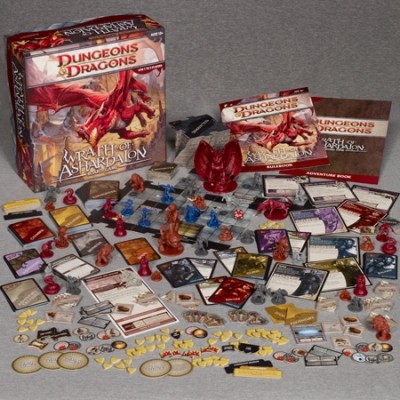
There are three games in the series: Castle Ravenloft, Wrath of Ashardalon, and The Legend of Drizzt. I’ve played all three, though I only own Wrath of Ashardalon. The details differ, but they all play pretty much the same way. Each player is an adventurer exploring the dungeon, facing monsters and finding treasure. The games are cooperative, so the players all win or lose as a team. The dungeon is built using square tiles which are drawn randomly as the board is revealed. The monsters are then placed on the tiles and activated depending on who’s turn it is. The best thing about the D&D Adventure system is that the action on the board is very direct. Rather than messing with line of sight and range, you simply look to see if the target is within a couple of tiles of your guy. If he is, then depending on the attack you use, you can attack it. If you’ve ever spent several minutes in other games deciding between two squares to land on, this simplicity is refreshing. I’m also a big fan of the system of tiles and villains. There’s a sense of the unknown there, and that’s pretty exciting. No doubt being a cooperative system has a lot to do with this. Since there isn’t one player “in-the-know,” it fosters a real sense of camaraderie that similar games lack.

Combat is resolved almost totally by a single roll of a d20. Here is where things get very difficult. You roll this die a lot. It’s used to resolve countless situations, from combat to status effects, and in many cases a failed roll can be the difference between close success and crushing failure. And there really isn’t much way to modify the roll. You can get weapons that add to your roll, but even in the best of situations your odds of success rarely get above 50/50. Those are pretty stark odds for a roll that might end up determining the game. I don’t mind luck in games at all, but this might be a little sharp for some people. It’s not so much difficult as it is capricious. Those who are used to the manageable luck of games like Pandemic will probably find this to be too random for their tastes. Taken with the right attitude however, I don’t think it’s an issue.

The problem is, I’m not totally sure the game knows what attitude you should play in. While the action on the board is appealing and simple, there are other aspects of the game that are impossibly cluttered. The biggest culprit is the piles of cards that each player keeps in front of them. Statuses, character abilities, weapons, treasures, and enemies all pile up in a hurry. And this isn’t information you can just forget about either. You will need to be familiar with those cards to have a shot at defeating some enemies. The result is that the game almost drowns in stacks of cards. They tend to be a little heavy on text, and because of the lack of illustrations on the cards themselves it can be easy to confuse them. The only game that is comparable in this aspect is Arkham Horror, a much heavier title.

The problem is, the D&D games want to have it both ways. There is a vein of “seriousness” in the cards and statuses. Why would there be so much stuff to manage if the player was not meant to strategize and plan every move? But such planning is moot when a single die roll is just as likely to sink your game as anything else. And if that die roll won’t kill you, a later one probably will. The game wants to be straightforward and short, but the clutter that plagues other dungeon crawls cannot be avoided. It’s not helped much by a loosey-goosey ruleset that almost seems bored with rules explanation. It’s great to get you going, but don’t expect any help when a question pops up. If you play with thinkers, this 90-minute game can easily balloon over two hours.

That said, I like these games. If you keep things fast and casual, all three games are an good choice. The stacks of cards everywhere can be glossed over if you don’t mind forgetting stuff now and then. The squishy rules can usually be table-ruled without any problem. Indeed, the biggest strength of the system is how flexible it is. It’s clear that the players are meant to bend it to their needs, and in that regard the game is a success.  And because there are three different sets, you can start combining stuff just as easily as you can keep one box. You can even play solo, although I’ve never liked the solitaire game very much. Unfortunately, a lot of people don’t play games that way. I know that I can’t usually be bothered to tinker with a game, and a lot of other people will probably just move on instead of fine-tuning.

And so I find myself somewhat torn on the D&D Adventure games. On one hand, I admire the  simplicity of the action on the board, and the accessibility of the dungeon-crawling experience. But I wish they had been able to carry that design philosophy through to the nuts and bolts of the game. As it is, I think it’s in an unfortunate place where it’ll be too casual for heavy gamers, and a little too much trouble for casual gamers. That’s not a horrible place to be. After all, that’s why they invented the term “middle-weight.” I’m certain that WotC intends to use these games a lead-in to the full D&D experience. But it does mean that the game doesn’t really bring it’s own fun. You need to make it work for your group, either by tweaking rules or agreeing to just not take it seriously. I wish the game could do a little more heavy lifting in that regard, but what’s in the box is still pretty good.

 

Nate Owens is a weekly columnist for Fortress: Ameritrash. He drinks too much coffee and likes the Star Wars prequels. You can read more of his mental illness at The Rumpus Room.

Powered by JReviews
Comments (25)
  • avatarSuperflyTNT

    This is where Loter calls you an idiot. :)

    I disagree wholeheartedly on virtually all of your points, for the first time. You talk of the D20 luck factor being "too sharp", but really, it's not. There's a low probability of a hit with many attacks (fputting to someone who enjoys heavier fare. It's like someone who eats Dove bars "slumming" and getting a cone off of the Mr. Softee truck. They're both enjoyable if you're the kind of guy who enjoys both vanilla loaded with sprinkles and more nuanced flavors.

    I don't think there's that many cards and whatnot to deal with. Considering the competition, Tomb, Descent, and others, it's on par with other dungeon crawls and/or adventure games.

    Quote:
    But it does mean that the game doesn’t really bring it’s own fun. You need to make it work for your group, either by tweaking rules or agreeing to just not take it seriously


    What the hell is this? The game is fun irrespective of the group, unless you play it with a bunch of cube hugging douchebags who are really only playing because they need to prove their brilliance to everyone since their "sport" was "chess club" in high school or something. I absolutely refute this sentiment.

    The rules don't need tweaking at all. If you're trying to talk about scenarios, well, I made the second best adventure on BGG (according to a poll, for what that's worth) and everything I did was well within the confines of the rules. That's the brilliance of the game - it is a loose knit framework that is more of a sandbox with some pre-made scenarios, akin to LNoE in that regard.

    Short version: couldn't disagree with you more on almost all of your assertions.

  • avatarEgg Shen

    I like what WotC did with the D&D Adventure System, but I can't say that any of the three games are among my favorites. They are certainly fun to play, have excellent components and a simple, approachable rule-set. I agree with Nate that these are more of a "stepping stone" for those not familiar with the D&D RPG. That being said, they are still fun boardgames and worth it for fans of light dungeon crawlers.

    My main complaints with these games are small, but certainly enough to keep me from constantly playing them. The lack of illustrations on the cards bugs me (the artwork for the recent D&D Command looks amazing...not sure why the Adventure games got nothing). My other complaint is that the game doesn't work as well as a game with a dedicated DM/GM. Some might disagree, but I like facing off against an actual person in a dungeon crawl/adventure game. It creates a level of unpredictably that usually results in more memorable games. The automated system developed for these D&D games is excellent, but I would be lying if I said I didn't miss having a friend controlling the horde of evil guys.

    Plus the fact that its co-op leads to people just doing things because they playing against a system and not a real person. When that stuff happens it feels more like a puzzle and less like a dungeon crawl.

    These aren't things that cause me to hate the games or anything. I still enjoy them, but I can't help but feel there is still room to improve them.

  • avatarSuperflyTNT

    You just hit on the head what I LOVE about this series - they managed to make a co-op game that ISN'T puzzley.

    The monster movement is certainly predictable and puzzly, but the encounters make every game unique, and it's not something to "solve" as much as a true adventure.

  • avatardragonstout  - re:
    SuperflyTNT wrote:
    You talk of the D20 luck factor being "too sharp", but really, it's not. There's a low probability of a hit with many attacks (fputting to someone who enjoys heavier fare. It's like someone who eats Dove bars "slumming" and getting a cone off of the Mr. Softee truck. They're both enjoyable if you're the kind of guy who enjoys both vanilla loaded with sprinkles and more nuanced flavors.

    Pete, I tried, but I have no idea what this is saying.

  • avatarSuperflyTNT  - re: re:
    Quote:
    You can get weapons that add to your roll, but even in the best of situations your odds of success rarely get above 50/50. Those are pretty stark odds for a roll that might end up determining the game.


    This is flat wrong; traps are a large part of the game and you have a 3 in 4 chance of disarming with a thief. He's also forgetting that monsters have the same shitty odds to hit, which means that it's an equal playing field.

    Quote:
    I don’t mind luck in games at all, but this might be a little sharp for some people. It’s not so much difficult as it is capricious.


    This is also pretty presumtuous. It's not subject to sudden changes because the odds are always pretty low for a hit or to be hit.

    That was supposed to be, "not offputting to someone who likes heavier fare - sort of like a person who enjoys fine foods who also enjoys common foods (ice cream analogy)"

    A lot of my post was apparently lost to iPad.

  • avatarSan Il Defanso

    Well Pete, all I can say is that I'm only going on my own experiences. I gave these games a lot of chances to impress me. Most of those games bogged down while people stopped to read statuses. The piles of cards also means that stuff gets missed, since a lot of stuff is supposed to happen at certain times on the turn. It has proven to be a little too easy to get lost in the upkeep of the game, for whatever reason. I wrote my own suspicions above. Playing with slow players is part of it, but my game buddies are who they are.

    And let's not forget, I said that I enjoy the games. I just feel like they weren't really willing to commit to the idea of being casual. It's still a little too cluttered for my tastes. The fact that the game is so flexible (on this we agree) is really what makes it worth having around. If it's too hard, add more healing surges or something. There's five of them in the box, after all. And the combination possibilities between the three sets is awesome. The problem is, "toolkit" games generally aren't my bag. At the very least, I don't like that a game has to be appreciated as a toolkit in order to really see its brilliance.

    As for the luck, you make a really good point that the enemies are just as likely or unlikely to hit you as the other way around. I didn't mention that, partially because 1) there are usually a lot more enemies than there are heroes and 2) the penalties for failing an attack are usually far more dire than a monster's attack missing is positive.

    I admit, I'm probably thinking too hard about a game like this. The fact that I couldn't just get swept up in the game is a problem though. Maybe my problem, but I suspect it's the game's problem too.

  • avatarMichael Barnes

    But it does mean that the game doesn’t really bring it’s own fun.

    Like hell it doesn't. It gives you an old fashioned, hack-and-slash D&D experience with new fashioned rules that anyone can enjoy. Don't overthink it. Roll D20s, kill Kobolds, pick up loot. Yay!

    You can't get into the beard-scratching and "hmming" over die rolls, worrying about balance and all. This is a premier fun-first design. If you want the more hardcore, serious, and rules-heavy experience there's Descent. This is closer to Heroquest by design.

    As for the statuses, lay smoke you dick and use overwatch. They're simple, and most are practically self-explanatory. Most last a turn, if I'm not mistaken. There aren't but what, five anyway?

    I think you're right on the money about one thing though, the rules are intentionally soft and malleable to give players some leeway in interpretating and playing the game. But I have seen that break down with people who absolutely insist on "OFFICIAL RULINGS" and all of that silly garbage. Most folks that just want to kick back and have fun don't care which square the damn monster is in.

  • avatarwadenels

    Great review. Sums up pretty well how I feel about Wrath of Ashardalon (haven't played the others). Our downfall most of the time is keeping track of the effects, abilities, and cards that affect our characters. When you're focused on what's developing on the board it's easy to forget the all the little things to keep track of near your character card

    I wouldn't say the game isn't a little bit puzzley. I mean it isn't Pandemic-puzzly, but it has its moments. Ever move back a few squares just to get onto another tile to get out of a monster's range? Ever have your adventurers move in an unnatural tile-hopping manner to avoid attacks? We have. It doesn't take much away from the experience the game tries to provide, but it does remind you that you're playing a game system.

    I still really like Ashardalon though. Since it's a cooperative game with no DM/GM you know the game isn't gonna show you any mercy. It also won't give you time to recover or regroup. The monsters will always come for you.

    I've been thinking that Ashardalon would make an excellent RPG-like hybrid. Use all the game's components, but instead of using the rules as printed just take a rules-light system like Risus or Tales of Blades and Heroes and roll with it. We've tried this once with Risus with me being the DM and it worked pretty well. It could have been better, but I was pretty much making stuff up as we went.

  • avatarSan Il Defanso

    Barnes, I agree that this is a fun-first design, but for me it's been the frustrating side of designs like that. I've played a couple of games where everyone was much more laid-back and goofing off, and those were usually far better experiences. The fact that I've had as much trouble capturing that kind of lightning in the bottle again is what gives me pause. It's meant to be played fast and loose, but there's enough there to trip up most of the people I play with. We can't all be at Swamp Castle every week, I guess.

  • avatardragonstout

    When San complains about "statuses", I don't think he's talking literally about the poisoned/stunned/etc. statuses, but about the billion item powers and character powers you have in front of you, which are especially frustrating to me because they barely do *shit*. +1 to attack? Sweet, that will matter 1 out of every 20 times I use it! Since I probably won't use that ability 20 times in the game, it may or may not matter *once* in the game. THAT is practically the definition of the word "fiddly".

    And when San complains about the 50/50 odds being stark, the point is that everything is incredibly unreliable one way or the other. 50% chance to hit means that if you attack two monsters, sure, "on average" you'll get one hit in, but 25% of the time you'll totally miss both times and be completely screwed, and another 25% of the time you'll hit both times and it'll be a cakewalk. So you get these extremes, and not a lot of gradation in between. I agree with San about this "win-or-fail" thing being something that annoys me in games; it's what put me off of Conflict of Heroes so much, and was one of the worse aspects of Descent, too: in Descent, basically all you cared about was the "X", which meant you totally missed, as any other result typically killed the monster immediately, as the hit points were all too low. I like to be able to almost kill monsters, or half-kill monsters.

    Ugh, and San didn't mention it, but don't get me started on the bizarro tile system, where you have to pay a ridiculous amount of attention to the tile borders (because frankly, ANY attention you're paying to that as a hero is a ridiculous amount).

    I'd also take issue with San claiming that you can combine stuff from the three games easily; despite all using the same system, it's kind of shocking how incompatible they've made the three games. Let's see, how have they fouled up what should be incredibly easy...you have heroes with powers that apply only to statuses in their own box, making them useless against anything in the other boxes; you've got drastically different power levels in adventure cards, heroes, and monsters between the boxes; you've got the opposite problem with the tiles, that there's such *lack* of variety in the tiles that combining the boxes does absolutely nothing; you've got a monster activation system that derives key tension from the possibility of multiples copies of the same monster being in play at once, which of course won't happen when you combine sets; and finally, you've got a total lack of support from Wizards for combining them with suggested quests.

  • avatarSan Il Defanso

    Clearly Andy should have written this article, because he just explained my feelings better than I did.

  • avatarJeff White

    True dungeoncrawls or not...these are the greatest dungeoncrawl games ever made. Full stop.

    The downside is they coulda been even better. Real art on the cards, custom character generation ala AHQ, and true level advancement (maybe up to three only) via short randomly generated campaigns and they would be untouchable.

  • avatarldsdbomber

    I love that pete uses a Dove bar as an example of nuanced flavours :)

  • avatarldsdbomber

    dragonstout:
    can you elaborate a little on Conflict of Heroes, I keep meaning to pick up Storms of Steel because I love the Eastern Front tank smackdowns, but your description is a bit worrying

  • avatarColumbob  - re:

    The 50/50 to hit is bull. I played the thief in Wrath last week and my dailies (regular attacks) hit at +7. We'll agree most enemies don't have 17+ AC, more like 14 or so, giving me 60-70% chances of hitting, even more with the +1 magic weapon.

    San Il Defanso wrote:
    As for the luck, you make a really good point that the enemies are just as likely or unlikely to hit you as the other way around. I didn't mention that, partially because 1) there are usually a lot more enemies than there are heroes

    If this is your experience, then you're clearly doing something wrong. You need to clear the enemies (at least some of them) before going too much further, because every new tile laid down will bring some more and then you'll be in trouble.

    In the same referenced game last week, we couldn't hit the wide side of a barn and the legion of devils arrived, there were about 5-6 monsters for 3 heroes, this is pretty much the most I've ever seen. Things were looking really grim as it was still early in the game and the healing surges were already needed. We caltropped the 3 devils, managed to kill 2 of the others, suddenly things were looking up. Still, a couple of those were sentries and if left alone in the middle of a room with all explored edges, they're harmless and won't attack if you're far enough. To be competitive in these games you have to look at the monsters' rules and anticipate what they'll do. We found the room and destroyed the portal in a couple of attacks.

    I also take issue with this statement:

    Quote:
    But geez, have you ever read a D&D sourcebook? For that matter, have you ever read any RPG book? They are insanely complex to the uninitiated, and even to some old pros.

    These aren't complicated by any means, they're just long. People are daunted when faced with reading hundreds of pages, without even trying to crack open the pages and understanding what's written on them. Lots of rules for covering many eventualities, but not much complexity.

  • avatarSuperflyTNT

    The short version, it sounds like, is that San has a group that likes cubes and this didn't jive with them. So, it ruined his time. He likes it, but his group doesn't, and the bitches he put forth are those aired at the table.

    I find most of them fallacious on their face, but they're his opinons. I think he suffered from sour grapes on behalf of his friends, which caused him to say that the game doesn't bring fun on its own.

    Oh well.

  • avatarSan Il Defanso  - re:
    SuperflyTNT wrote:
    The short version, it sounds like, is that San has a group that likes cubes and this didn't jive with them. So, it ruined his time. He likes it, but his group doesn't, and the bitches he put forth are those aired at the table.

    I find most of them fallacious on their face, but they're his opinons. I think he suffered from sour grapes on behalf of his friends, which caused him to say that the game doesn't bring fun on its own.

    Oh well.

    They aren't all cube pushers, to be fair. We've had plenty of success with Wiz-War, Dungeonquest, and King of Tokyo. We can loosen up and play. These games have never taken off like I hoped they would though. I still like them, obviously.

  • avatarSuperflyTNT
    Quote:
    Combat is resolved almost totally by a single roll of a d20. Here is where things get very difficult. You roll this die a lot. It’s used to resolve countless situations, from combat to status effects, and in many cases a failed roll can be the difference between close success and crushing failure. And there really isn’t much way to modify the roll. You can get weapons that add to your roll, but even in the best of situations your odds of success rarely get above 50/50. Those are pretty stark odds for a roll that might end up determining the game.

    Nate, I'd like you to elaborate on this, please, because I cannot, for the life of me, see where you got this from. It really appears to be factually inaccurate at best.

  • avatardragonstout

    Yeah, it's been a while and I only played Castle Ravenloft, and I defended what San was talking about up above, but my memory of CR was that I felt like the rolls were *too* likely to hit.

  • avatarSan Il Defanso

    Well, I was ballparking in my head, and that's a good way to bend memories to how I want them to be. So the 50/50 is probably a conservative estimate. Maybe it just feels this way because of bad luck, and because I probably suck at the game.

    I still think that the consequences of failure are a little extreme. Death Angel has similarly high-stakes rolls, but it brings something extra with the support tokens. Maybe I'm just a pansy and want some way to reroll bad rolls.

  • avatarColumbob

    You do usually need to roll 10+ to get rid of poison or to disarm traps or other effects.

    Most enemies also need far less than 10+ to hit the heroes though, often a 4-5 is enough to hit the mage or thief.

  • avatarSpace Ghost

    Nate,

    You mentioned the popularity of dungeon crawls in the 80s and 90s. Previously you have mentioned coming to the board game hobby later than others. Did you get a chance to play the early dungeon crawls....especially when you were young? If not, I expect that is a big reason these games aren't connecting as they are with others.

  • avatarSan Il Defanso

    I was raised in a pretty religious home (and I'm probably still one of the more religious guys here), so there wasn't much presence of D&D, Heroquest, Warhammer Quest, what-have-you. Combine that with the fact that I spent a lot of time overseas, and it was a perfect storm for this kind of stuff to be totally outside of my awareness. I do remember seeing a friend who had Heroquest in his bedroom, and we tooled around with the very cool pieces without actually playing the game.

    I had never considered that part of my frustration with these games might be my upbringin', but that's a distinct possibility.

  • avatarjpat

    Isn't part of the problem with the d20 resolution mechanic that the d20 has a flat probability curve (i.e., an equal chance of rolling any number between 1-20), meaning that the only way to adjust the number is through modifiers? It's an obvious carryover from D&D and it has a nostalgic appeal to me, but it does add a kind of extra-lucky luck that the game has to compensate for by giving some crazy-high bonuses to hit. Maybe that's why the game feels a little swingy to Nate.

    I like the D&D Adventure series games, at least Ravenloft (own WoA but haven't played it), but they do seem to fall a bit between the two stools of light game and serious game and not really polished enough to be more than a pretty good time. I will say, at least, that components wise these games by and large thump the much more self-serious Descent 2e. I hadn't played Descent 1e, but I was shocked at how small the tiles were compared to the D&D ones.

  • avatarColumbob  - re:
    jpat wrote:
    I will say, at least, that components wise these games by and large thump the much more self-serious Descent 2e. I hadn't played Descent 1e, but I was shocked at how small the tiles were compared to the D&D ones.

    It's not all about size, I'm sure the D2 tiles are a lot nicer to look at than the bland grey D&D tiles.

Only registered users can write comments!
Text Size

Top