Games
Games How to resolve AdBlock issue?


 I like Battlestar Galactica and yet I have found myself largely unable to join in the seemingly endless torrent of love and praise that it has garnered during the short eighteen months that it has been in existence. I’ve had a lot of fun playing it and yet it seems that each and every time I sit down to that board (and I’ve never yet been dealt as a Cylon), and set about passing those skill checks, there’s something strange niggling at the back of my head. “There’s something wrong here” it seems to be saying, “this game is fooling you into having a good time when you shouldn’t be”. At first I thought this was some strange piece of residual guilt about the fact I should probably be mowing the lawn or learning ancient Latin or putting up shelves or something else that is rather more mature and constructive than pretending to try and save humanity from evil robots, but if that were true I’d get it every board game I play. And I don’t. So what is it about BSG that niggles so?
It just so happened that I was playing BSG during the final moments of 2009 and the first of 2010 and as the clock struck midnight and humans and Cylons alike joined hands to sing “Auld Lang Syne” I had an epiphany and got my answer. Three adults were playing against three teenagers in that game and I was certain that the teenage girl at the table was a cylon - her card actions seemed to dictate that she had to be, as logically she must have been laying some sabotaging cards into skill checks. My other known-humans were far less certain and as it turned out they were right: she was in fact human but she was enjoying the game in her own way by pretending she was a Cylon, partly to see what the game looked like from the other side and mainly just to screw with everyone’s head. As it turned out she eventually got her wish by being dealt a sympathiser card and becoming a Cylon and humanity crashed and burned one jump away from salvation. And at first I was slightly irritated that my fellow humans and I had lost partly because she’d chosen to deliberately send out false signals about where her loyalties lay.
But pretty quickly I realised that she was just having fun, and in fact we’d had quite an unusual and exciting game session because of her duplicity, and it didn’t matter any more: fun and excitement being the main things you want from a game. But the experience crystallised what it was that had been annoying me about BSG: the entertainment value of the game has virtually zero to do with the bulk of the game mechanics or the bulk of the actions taken during play. What’s interesting about playing is pontificating about who is and is not a Cylon, whereas what you spend most time doing is throwing cards into skill checks. Worse, when viewed from a purely mechanical angle there are aspects of the game which become peculiarly pointless. As others have noted, you start to wonder after a while why Cylon players bother staying hidden: a lot of the time they can actually be a whole lot more destructive by revealing early and using Caprica locations than trying to undermine skill checks by throwing in the odd bad card. And the sleeper phase mechanic can mean that the side you’ve spent the whole game trying to support is now your enemy, so a strictly game theory analysis of the choices on offer would suggest it’s not a bad plan for even the human players to start sabotaging their own efforts in case they get a Cylon card. But yet the game is still fun: they Cylon players stay hidden because it’s more fun than being revealed and the human players carry on being human because it’d be treacherous to behave otherwise. And those are the only reasons why this strange old starship keeps flying. Were it any other way it could be consigned to the dustbin of any number of other failed TV tie-ins.
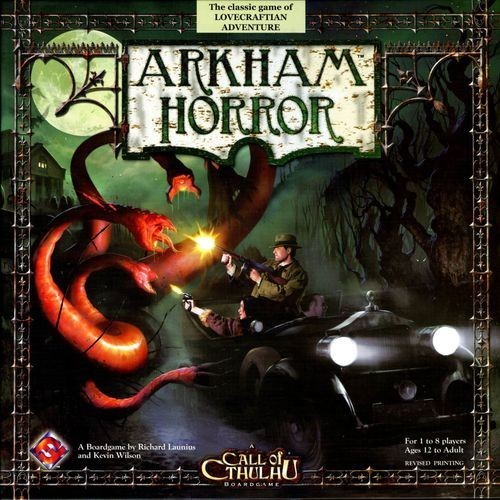
Anyone who doubts that this is so should try playing the solo variant on offer as a download from FFG. It’s really boring and involves an inane amount of administrative overhead to keep going. And while BSG is about the worst offender I’ve found in this regard, once I’d spotted what was going on I began to see overtones of it in lots of other games. In Arkham Horror for example, especially playing just the base game, often the most mechanically rewarding strategy in terms of getting a win is simply to look at the Ancient One’s card and tool up for the final battle accordingly. And yet players persistently make the collective decision to go for gate closing/sealing wins. When you look at the overhead involved in setting up and playing a game of Magic Realm it’s a wonder anyone ever does in the age of Realmspeak. Indeed Magic Realm would win awards from me for being both the most overrated and the most administratively demanding game of all time. And yet it continues to draw legions of followers and indeed converts to its questionable charms.
Indeed following this train of through I even found it could be extended to my favourite game, Twilight Struggle, a masterpiece which I had hitherto assumed was above reproach. After playing 60-70 games of this classic title I had begun to develop the sneaking suspicion that rather too many games were decided by early-yet-significant dice rolls such as coup attempts in Europe and Asia and War events in Asia and the Middle East. These things can determine the controller of a points-rich region which can easily continue unchanged for the entire game, especially in Europe. And yet even as this suspicion began to fester, I continued to play the game avidly, loving every minute of it. Why? Because much of the pleasure in Twilight Struggle comes from getting a new hand of cards each turn and planning desperately to try and minimize the bad effects of enemy events, maximize the value of your own events and still have enough cards to play for operations to do something useful. Actually winning the game is almost an afterthought.
When I first applied this thinking to Battlestar Galactica I figured that I hadn’t really stumbled upon anything particularly interesting. It is, after all, merely another way of demonstrating the truism that the best games are always, always, greater than the sum of their mechanics, often for reasons which defy analysis. But then I realised that I was advocating something further: that a number of games didn’t merely go beyond their mechanics but actually had a gulf, a division between the mechanics and what made them fun to play. Not only that, but this applied to a number of my very favourite games. What was going on here?
What I’ve started to suspect is that a lot of games are fundamentally satisfying needs other than those which they appear to advertise. When most of us think about games I’m willing to wager we’re mainly interested in one of three things: intellectual stimulation from strategic decision making processes, thematic immersion or just sheer animal excitement as the dice or cards tumble out of sweaty palms and onto the table. And certainly most games offer some or all of these things as hooks to keep the gamer interested. But what differentiates the some games is that they’re offering a package of surprise extras which aren’t immediately noticeable but which actually override the pleasure gained from the basic things the game provides. The paranoia of wondering whether the player to your left is a Cylon. The joy of being a nun who rides a motorcycle and shoots zombies in the face. The sheer, naked terror of wondering what the Soviet player is going to do with Decolonization if you let the event trigger.
If I’m right, what does that say about games in general? Really it suggests that mechanical analysis as a means of what makes a game great is a complete waste of time. It suggests that the reason why any particular game in any particular genre is better received than its competitors has very little to do with all the things that so many game geeks like to harp on about, things such as exquisite balance or challenging decisions or thickly applied chrome. It suggests, perhaps most hearteningly of all that even the most reclusive uber-geek is actually interested in rather more about the wider world than his narrow game obsession might suggest.