Games
Games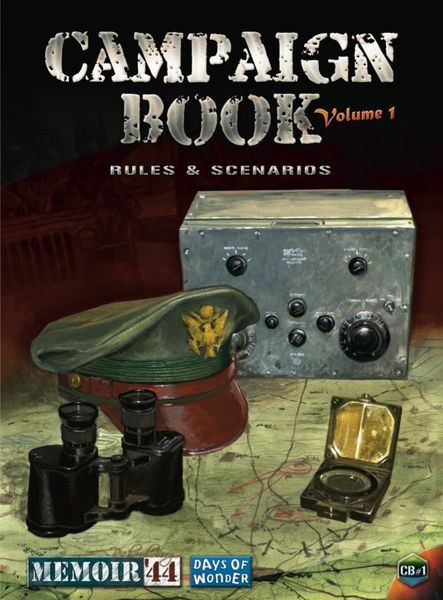
For some reason, I was struck relatively early on in my plays of Memoir ‘44 that it was a game that would clearly benefit from a campaign system. I’m not entirely sure why this was - perhaps it was a reflection on the relatively limited scope of most of the scenarios, or maybe because the pleasing simplicity and speed of the game left ample scope for an extension of both for those that wanted it. I can’t have been the only one because several home-brew versions appeared fairly quickly after the game was published. I was thus immediately interested once the semi-inevitable official version was announced, and Days of Wonder were kind enough to supply me with a copy to review.
Not having done a lot of pre-product research with this one I had assumed the book would be a cheap softbound and so I was surprised and pleased to find that it’s actually a top-quality hardback book which includes some new markers needed to play the campaign system and some of the new scenarios, as well as some new reference cards in the back. The reference cards fit in with those from the Air Pack expansion and so aren’t any use if you don’t own that, but the production quality is still top-notch. The whole thing is laid out to look like a stack of military briefing papers and while it’s text-heavy, the illustrations are good and there’s some solid history included in the notes.
The campaign rules themselves are very simple. A campaign is a sequence of linked scenarios, usually around 4 games in length. Each player keeps the same side through each game in the campaign rather than swapping as is the case in most one off M44 games. The system introduces two new dice rolls to each scenario, one before the scenario begins and one at the end. First there’s a “reserve roll” which allows players to add units matching dice symbols rolled to their forces for this game, although doing so drains a strategic reserve pool each player has for the campaign. Afterward there’s an “event roll” which has adverse effects on your opponents’ starting forces for the next game. The winner of each scenario gains a small benefit to carry in to the next scenario, as well as an extra event dice with which to torment his opponent. In some campaigns there is a tree of scenarios with different games being played depending on who won what earlier on. At the end of the campaign you total up all the victory medals earned by each side during each scenario and add a few bonus points for objective medals (i.e. medals earned from holding terrain rather than killing units) and the player with the higher total wins, although there are degrees of victory from a draw to a decisive win. If you want you can link shorter campaigns together into a grand campaign with its own special rules and determine an overall winner.
Those rules only take up around six pages - the remainder of the book consists of descriptions of the campaigns and the scenarios of which they comprise. A few of these scenarios are from existing sources such as the base game rulebook, but most, pleasingly, are completely new. There are three grand campaigns in the book. The first is based on the Normandy campaign, though excluding D-Day, which requires only the base game set to play. The second comprises the under-gamed German invasion of France and Belgium in 1940, and this also requires the Terrain Pack. The third and longest campaign covers aspects of the German Operation Barbarossa against the Soviet Union in 1941 and this needs both the Terrain Pack and the Eastern Front expansion. Many of the scenarios also feature optional rules for using the Air Pack if you own it, and one states that the Air Pack is required, although I’d say you can muddle through without it: I certainly managed. The requirement for two expansions to make full use of the third campaign is, I think, a mistake, as it will seriously limit the potential audience for this book. And that’s a shame because in terms of play experience, this is undoubtedly the best Memoir expansion yet.
One of best things about Memoir has always been its easy going nature: it’s a game to break out any time with virtually anyone, to start and evening or to end it. But that accessibility has also been it’s downfall in the sense that a stand-alone game of basic M44 is essentially a forgettable, throwaway thing. The “front” expansions added a lot of strategic depth and flavour to the game but this didn’t solve this basic problem. The campaign book at long last addresses the issue without taking anything away from the value of Memoir as an accessible game because of course you don’t have to play campaign games: one offs are still perfectly viable and as fun as ever. But suddenly the game has become one which can take up an entire evening, instead of just bookending it.
There are multiple aspects as to why I think the campaign system is so compelling and, perhaps surprisingly, very little of it has to do with the inter-game mechanics of reserves and events. They have a certain charm, and I do like the way the reserve rolls force a general into agonising choices over such things as whether to use a lucky roll - say for an elite armour unit - and burn a reserve token now, or save it for later and risk getting nothing but basic infantry in your rolls. What really does it for me in mechanical terms is the absurdly simple totaling up of victory medals across the campaign to determine an overall winner. Not only does this address the oft-quoted problem of a few lucky rolls determining a sudden victor in a single game (because now you have a comeback chance) but it means every medal - every single one - is worth fighting for. If you’re facing a certain defeat after ten turns of play no longer are you simply going through the motions until the game end but you’re fighting tooth and nail to try and salvage every medal you can out of the debacle. Better yet, those oft-ignored objective medals now give you bonus campaign points and so suddenly become extremely attractive - and exciting - to attack and defend. During a test of the “flanking Caen” campaign the final scenario saw an absolutely thrilling bloodbath over the single medal objective, Hill 112, because the side that got it would clinch the overall campaign. In a nice twist a couple of the 1940 Blitzkrieg campaigns have other bonus points on offer based on the historical importance of destroying tanks and denying mobility to the enemy.
History is the other key to what makes the campaign system feel so rewarding. Each campaign is given a historical preface in addition to the historical notes for each scenario. Regardless of what you thought about the simulation aspects of the base game, there was certainly a problem with putting individual scenarios in their historical context because they tended to be modeled on small-scale actions unfamiliar to most players. With the campaigns this is no longer the case - the grand campaigns themselves are based on history familiar to most high-school students and the smaller campaigns and individual scenarios are put in their proper place within the larger framework. For gamers keen on theme there’s an added bonus here: the chance to use a quick, simple game system to actually re-create a wholly imaginative version of history. Memoir might not feel like much of a simulation, but if you’re playing the 1940 campaign and taking the role of a French general has a chance to halt the Blitzkrieg and avert the entirety of the second World War, that won’t detract a jot from how good you’ll feel if you pull it off.
The scenarios that make up the campaigns are, for the most part, very good and a notch above the bulk of those found in the base game. The fact that most of them are brand new is really the icing on the cake and explains in part why this book was so long in coming - there looks to be a lot of design hours in this product. As we’ve come to expect from M44 scenarios, most are not balanced and favour one side (usually the historical victor) over the other although there are very few one-sided setups here: most offer both players a realistic chance to win. Since you’re no longer swapping sides you might think this would lead to a seriously unbalanced experience in playing campaigns but, of course, care has been taken to ensure that the overall campaign arc is roughly balanced. So in a campaign of 4 scenarios you’d expect 2 to have allied bias, 2 to have axis bias. This overall balance factor has even been exploited for variety: at least one campaign offers the choice of an additional scenario to play - altering the overall balance - to the victor of one of the mandatory scenarios in the campaign.
Which brings us on to balance in terms of campaign rewards. One of my opponents during the course of my review games stated a marked reluctance to try this game out because, he said, campaign systems always end up rewarding early victories too much and the later games become too one-sided. It’s a fair criticism. But again, the design team behind the M44 campaign system seem to have realised this and compensated for it - after actually playing a campaign my opponent agreed it was a very well balanced system. The most straightforward solution is the short scope of the individual campaigns which means there’s not too much time to build up momentum before a reset, but the points system used in the Grand Campaign means that the victor in a single campaign gains his just reward without making the task impossibly for his opponent. The additional event dice are also a clever idea: forcing your opponents to lose single figures from his units has a far bigger impact on the emotions than it does on balance. Seeing your enemy gleefully tossing one of your tank figures back into the box hurts - but of course your unit is still at full effectiveness until it dies.
From the point of view of the Memoir system as a whole, this expansion is hard to fault. The individual scenarios are great, it offers a whole new play experience with added depth and theme, and the excitement that can be generated by confrontations over single victory medals can be tangible. But of course most gamers don’t own the whole system, which brings us back to the unfortunate fact that to use two thirds of this book, you’ll need to own the Terrain Pack. If you already have that expansion then I highly recommend you get this one: it’ll inject a whole new lease of life into your play experience. If you don’t then the questions of whether it’s worth getting the Terrain Pack just to play the campaigns, or indeed if the base-game only campaign is enough alone to make the book value for money are rather more thorny. I don’t have an answer for this: I guess it depends how much money you have to spend and how much time you’re really likely to spend playing Memoir, although I guarantee that the book will certainly increase your desire to spend time on the game. That’s why I think it’s such a pity that so much of the book has an absolute requirement for one expansion.
As far as I’m concerned, the existence of the Campaign Book is the final nail in the coffin of all the other Commands & Colors games. They might offer their individual advantages but frankly, who cares now that Memoir can basically do it all? Given how good this supplement is I’m rather surprised how little attention it seems to have received outside of the hardcore M44 playing community. At the risk of repeating myself to the point of tedium I can’t help wondering if the limited reaction to this brilliant book isn’t at least partly a factor of its reliance on the Terrain Pack, which must have limited the scope of its potential market. Here’s hoping that any possible Volume 2 of campaigns isn’t so tied to a single supplement, but in the meantime I hope that this review might make up some of the lost fanfare that the Campaign Book richly deserves.